
What if chemical procedures worked like code? Think GitHub for chemistry.
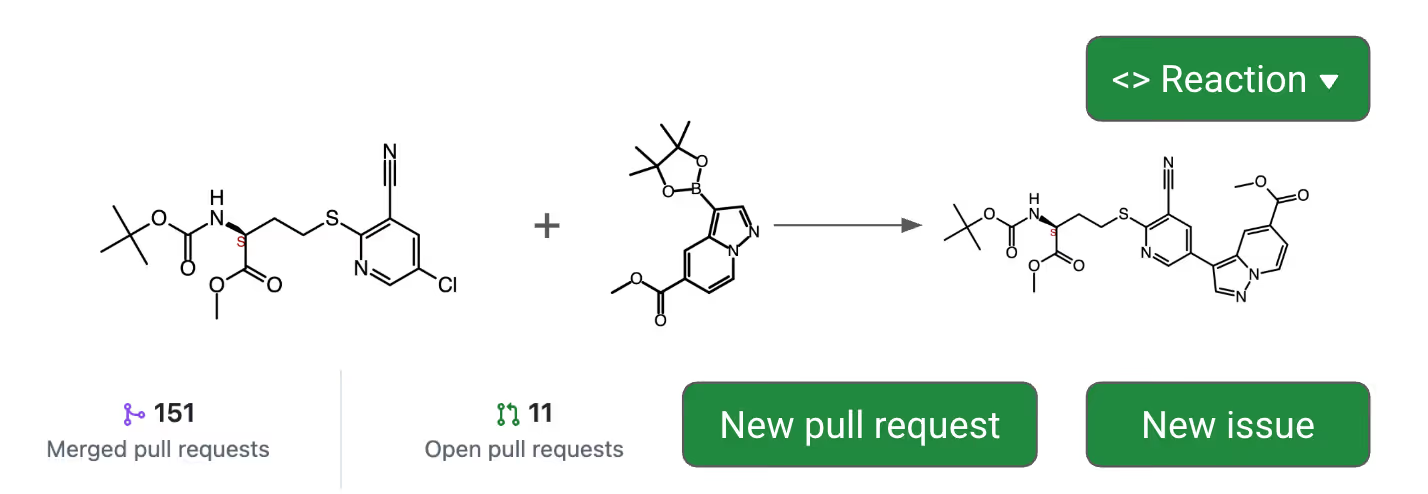
What if chemical procedures worked like code? Think GitHub for chemistry.
In software, progress is fast because the infrastructure makes collaboration effortless with automatic version control, branching, and pull requests.
Chemistry, even as it becomes more digital and model-driven, still lacks this foundation.
Imagine if experimental procedures behaved like code.
Every experimental campaign would carry full version history. When a step is updated, a parameter corrected, or an outlier flagged, the entire lineage stays transparent. No more scattered spreadsheets, overwritten files, or unclear protocol revisions.
Discovery and development workflows could branch like repositories. One team runs a reaction sequence; another forks the procedure to explore a new hypothesis - without overwriting anything, and with a complete view of the experimental context. Two ideas diverging and evolving in parallel, both preserved.
Experimental protocols could evolve through something like pull requests. Someone adjusts a quench, improves a sampling workflow, or fixes a systematic error - and the change is reviewed, discussed, and merged. Collective knowledge becomes structured and cumulative, not trapped in PDFs or tribal memory.
And while the results of chemical experiments are inherently noisier than software output, that’s exactly why structured, versioned procedures matter even more - noise demands context, lineage, and traceability.
Most importantly, reproducibility would finally scale across organizations. With shared standards for procedures, metadata, conditions, analytical outputs, and instrument specifications, discovery workflows and optimization trajectories would become portable.
Autonomous labs could truly interoperate.
This isn’t unrealistic - it’s simply missing infrastructure.
If chemistry wants the speed, reliability, and collaboration that software enjoys, we need to treat experimental procedures with the same respect.