
Chemical process development is evolving fast, and optimisation is no longer guesswork but a guided, data-driven strategy.
Chemical process development is evolving fast, and optimisation is no longer guesswork but a guided, data-driven strategy.
Once the discovery chemists have done their work, and you need to scale up a reaction, the key question becomes: how do we find the best possible reaction conditions for a transformation?
Temperature, solvent, catalyst, reagent stoichiometry, mixing, residence time - each parameter can influence yield, selectivity, robustness, cost, safety, and sustainability.
At ReactWise, we develop software for chemical process optimisation and directly support process R&D teams. We are starting this series to break down the mysteries and details of this, all the way from an introduction to the state of the art, and what will come next.
The traditional approach to chemical process optimisation involves intuition, literature precedent, and incremental trial-and-error. While this approach has led the field forwards for decades, it can be slow, resource-intensive, and sometimes blind to promising regions of chemical space. This is particularly true for multi-dimensional inputs, which are very tricky to conceptualise, and can lead to inconsistent approaches between labs, people, and even within campaigns.
To ensure consistency, techniques such as Design of Experiments (DoE) are used, exploring more of the parameter space effectively. However, due to the exhaustive approach to screening it can take a long time to comprehensively search for the right conditions - and adding just one more variable to an already complex system causes significant extra work.
Imagine you are half way through a DoE campaign, have found the most relevant regions and understand process robustness. Could you somehow skip most of the remaining experiments, completing only those that will add more value?
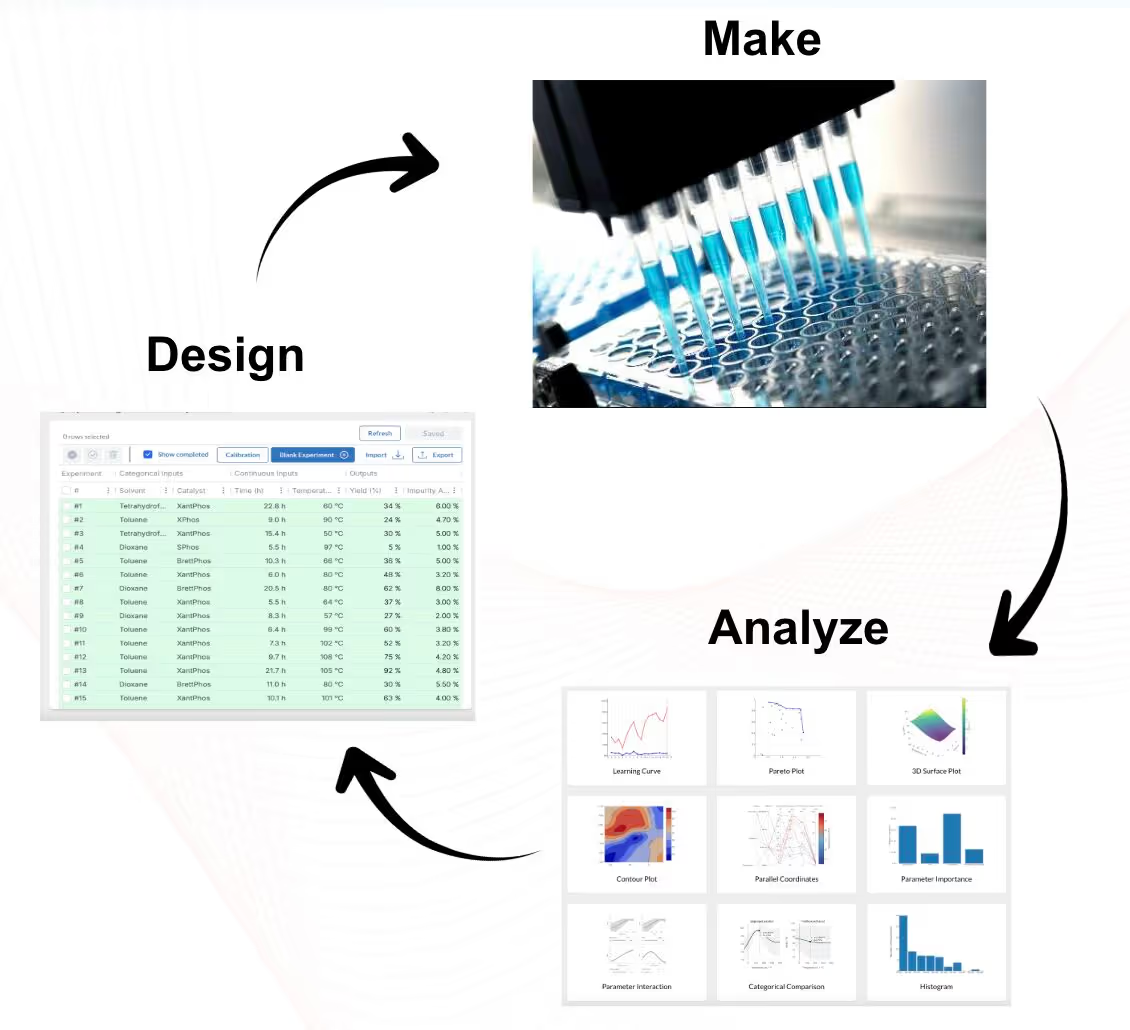
Bayesian Optimisation (BO) is the most widely used approach. It builds a surrogate model - generally a Gaussian Process - that predicts reaction outcomes from parameters such as temperature, solvent, catalyst, or stoichiometry. An acquisition function (e.g., Expected Improvement) then proposes the next experiment by balancing exploration of uncertain regions with exploitation of promising conditions.
This dramatically reduces the number of experiments needed compared to DoE or manual trial-and-error, while still mapping out the space and understanding robustness.
But what if you have more than one output?
Multi-objective optimisation is crucial in process development, where yield must be considered alongside impurities, cost, throughput, or sustainability. Data-driven methods can learn a Pareto front, allowing chemists to visualise the trade-offs and select conditions aligned with their priorities.
Data-driven chemical reaction optimisation is about enabling better decision-making throughout the lifecycle of a reaction.
Let’s build the next chapter of process development - together.