
Traditional reaction optimization - trial-and-error or one-factor-at-a-time - is slow, resource-intensive, and leaves most of the experimental space unexplored. ReactWise replaces that with a fundamentally smarter approach: Bayesian Optimization (BO), which learns from every experiment to tell you exactly where to look next.
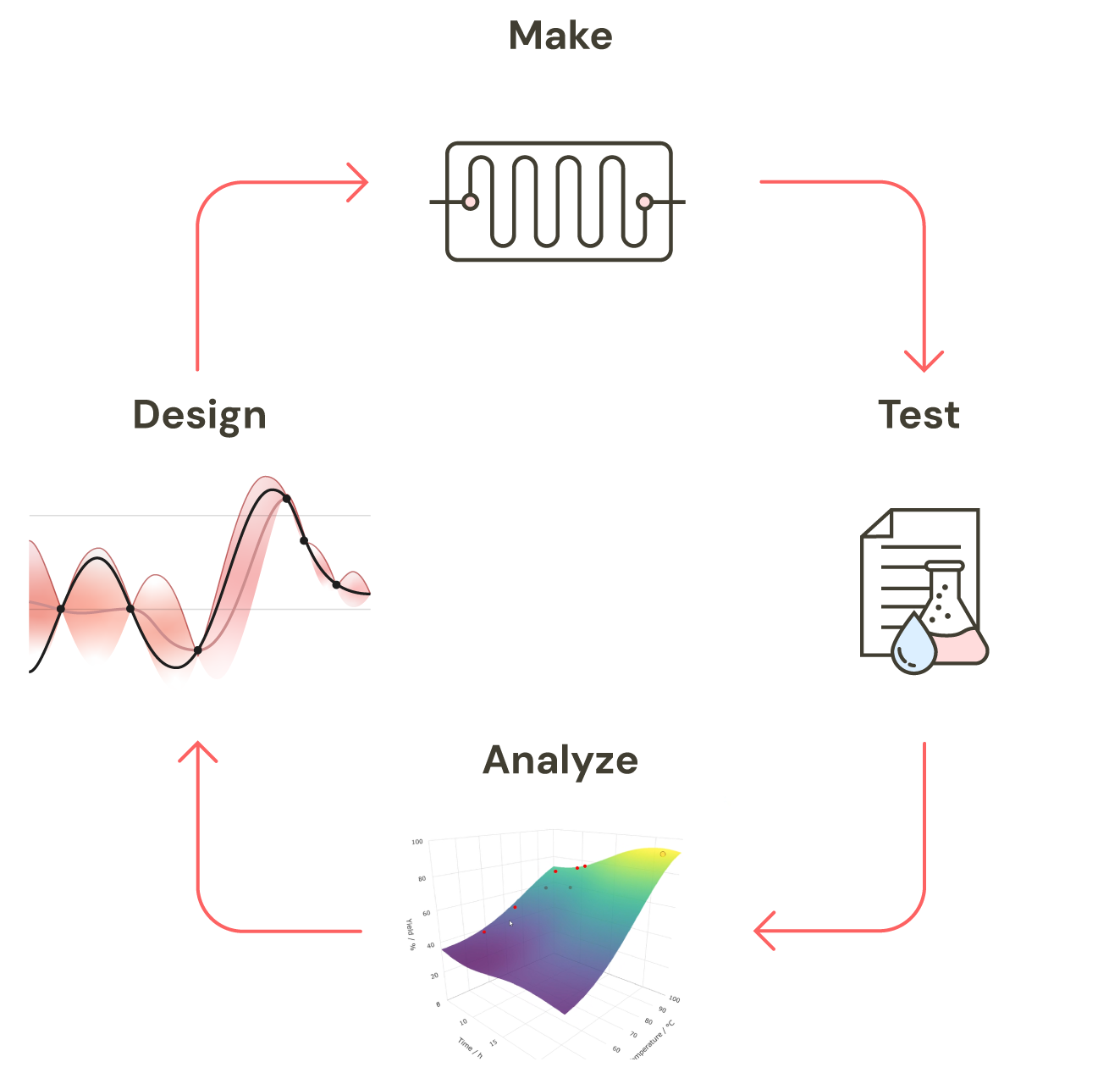
BO integrates directly into the Design-Make-Test-Analyze (DMTA) cycle. At its core is a probabilistic model - a Gaussian Process - that continuously updates as new data arrives. Critically, it doesn't just predict outcomes; it quantifies uncertainty. Every prediction comes with a confidence range (e.g., 78 ± 4% yield), and the algorithm uses this to automatically balance two competing priorities: exploring promising but untested regions, and exploiting conditions already known to perform well. The result is fewer wasted experiments and faster convergence on optimal conditions.
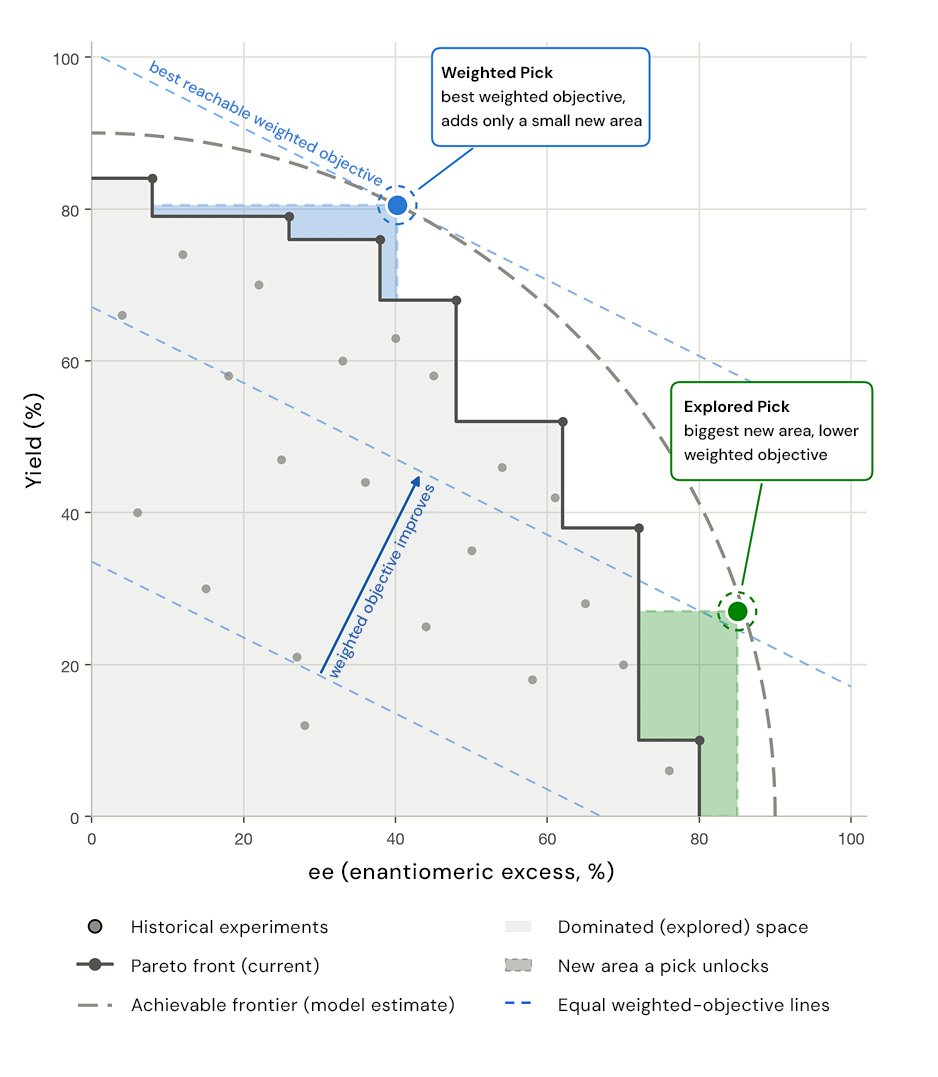
Multi-objective Bayesian optimization has to balance competing goals — here maximizing both enantiomeric excess (ee) and yield, which trade off against each other. ReactWise offers two optimization methods that pick the next experiment differently. Weighted objectives (blue) picks the experiment with the highest expected weighted objective, here 1·ee + 2·Yield: it climbs the dashed equal-value lines to the best weighted objective the model believes is reachable.
Explore trade-offs (green) instead picks the experiment that pushes the Pareto front out the most, unlocking the largest new area beyond what your experiments already cover — even at a lower weighted objective. Weighted objectives refines a chosen compromise; Explore trade-offs charts the full trade-off curve.
Standard BO is powerful - but it starts blind. Every new reaction begins from scratch, with no memory of what came before.
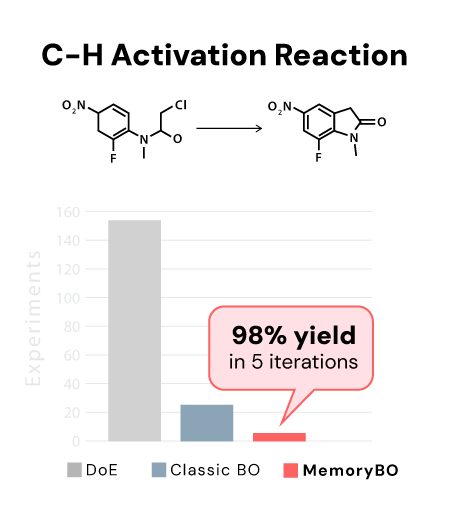
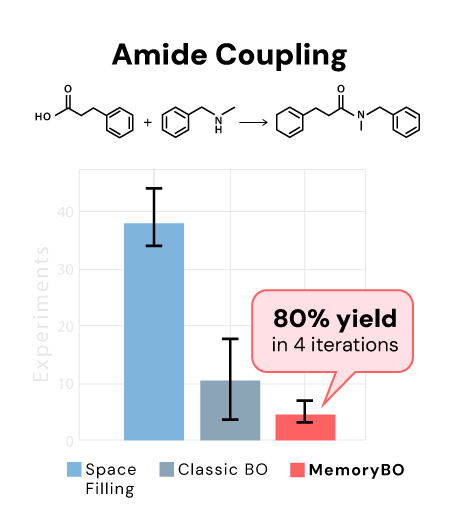
ReactWise’s MemoryBO® is built on Multi-Task Bayesian Optimization (MTBO), which changes this. Rather than treating each reaction in isolation, MTBO jointly models related reactions - those sharing common reagents, mechanisms, or conditions - and learns which historical campaigns are most informative for the current target, and to what degree. Before a single new experiment is run, the model already arrives at an informed starting point. As new data comes in, the model updates across all related tasks simultaneously - meaning insights flow in both directions.
The outcome
MTBO reaches optimal conditions significantly faster than single-task approaches, with the advantage most pronounced exactly when it matters most - early in optimization, when data is scarce and every experiment counts.
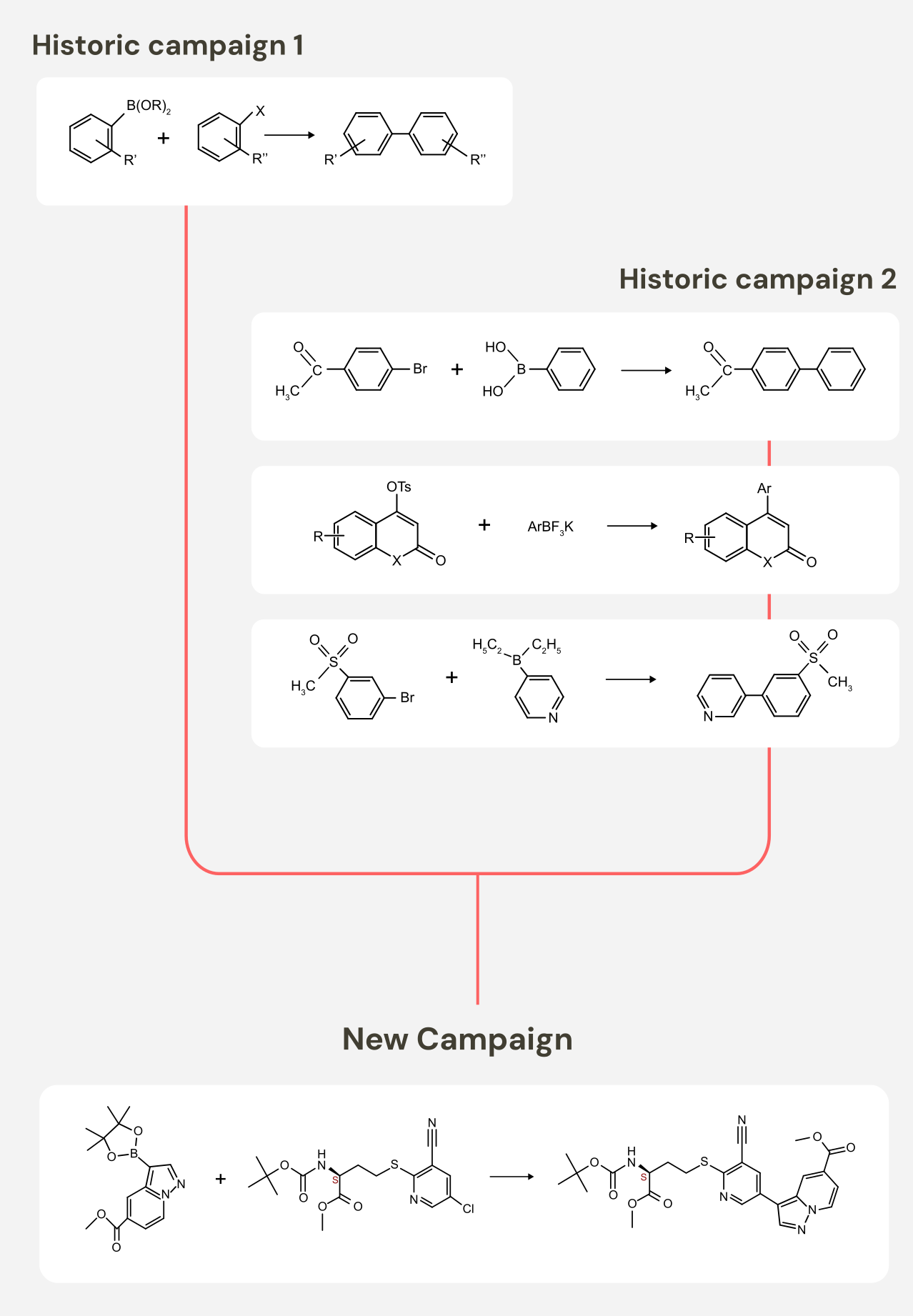
• Upload prior data of similar/related experiments.
• Map the prior data to your target task.
• Receive intelligent predictions from the start.
Vera is our AI assistant that learns as a campaign runs, reading the molecular descriptors behind each reagent and solvent alongside every result recorded so far. It recognises the chemical trends beneath the data, then draws on internal databases and the wider literature to reason about promising conditions the original screening space never contained.
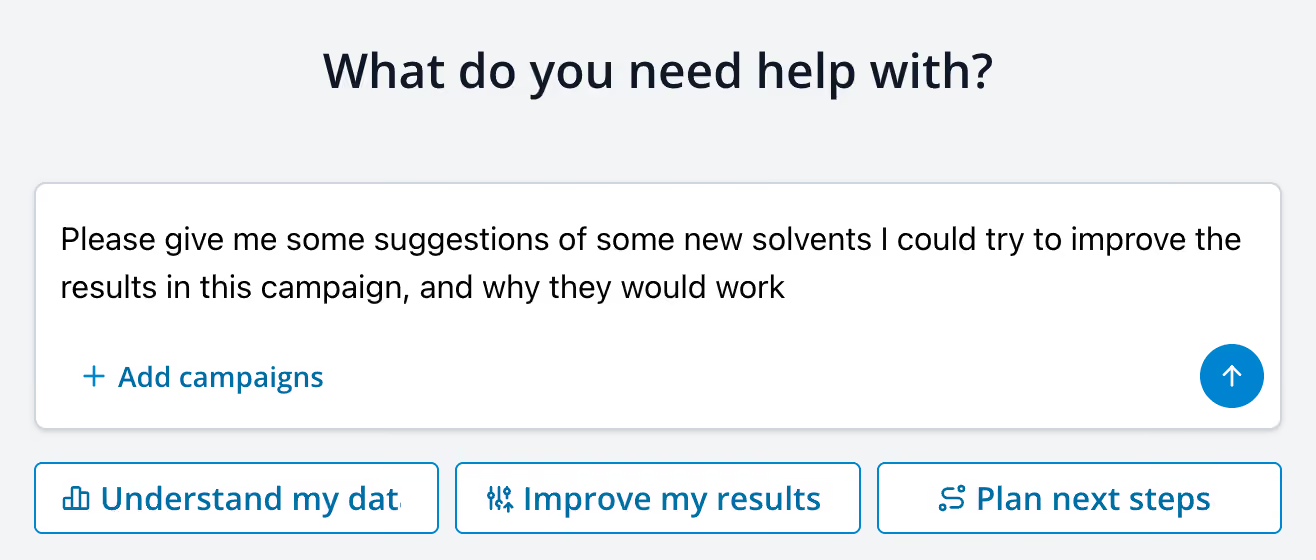
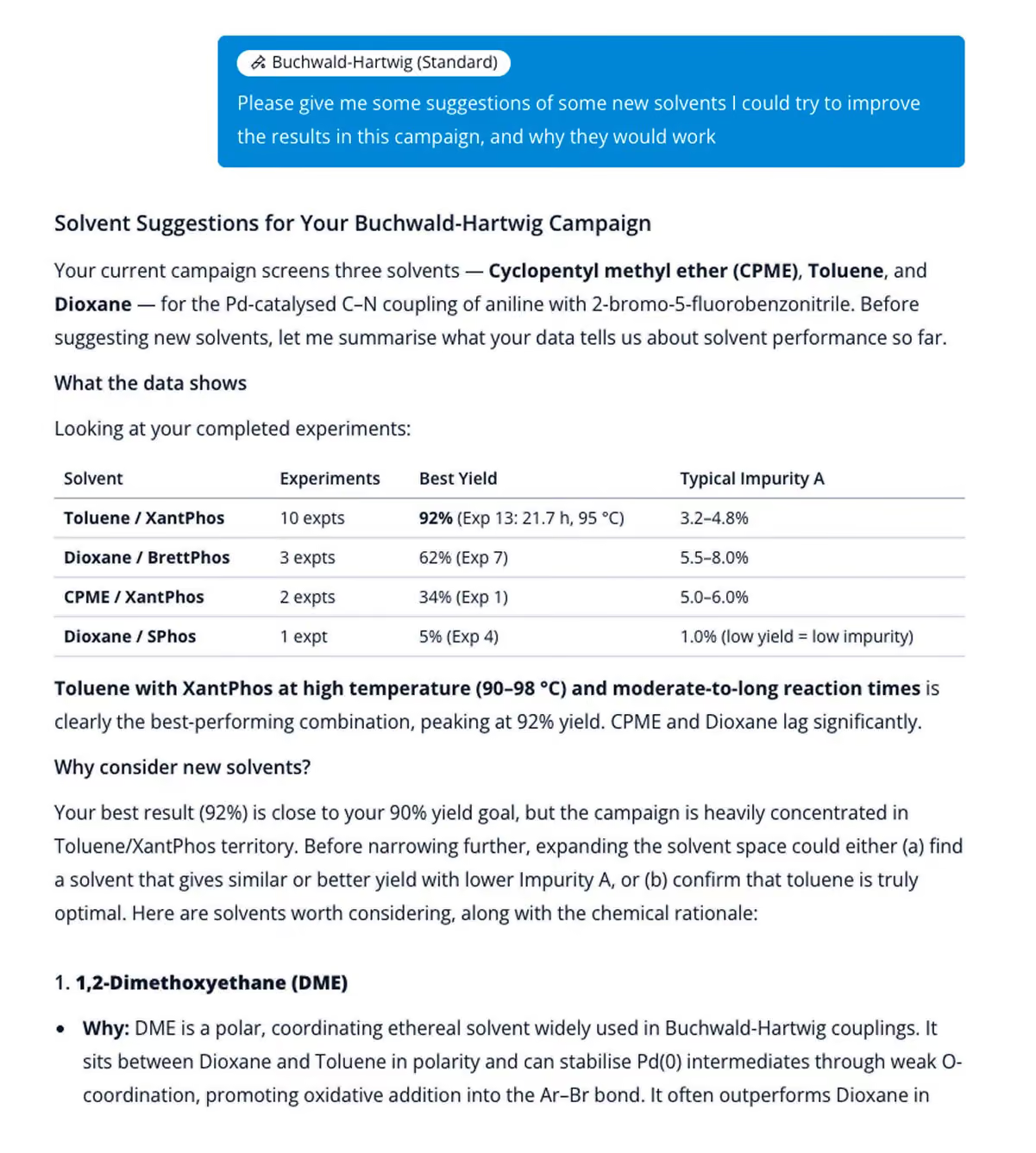
When a Bayesian optimisation run plateaus below target, Vera suggests where to look next: a greener solvent with comparable performance, or a ligand class outside the original panel that the observed trends favour. Chemists explore a wider, better-chosen space in fewer experiments, reaching viable conditions the screen would have missed, and can draw on Vera for a range of inspiration. All data is kept private and confidential, for more information see our trust page.