
Intelligently expand your parameter space using Vera, our AI assistant
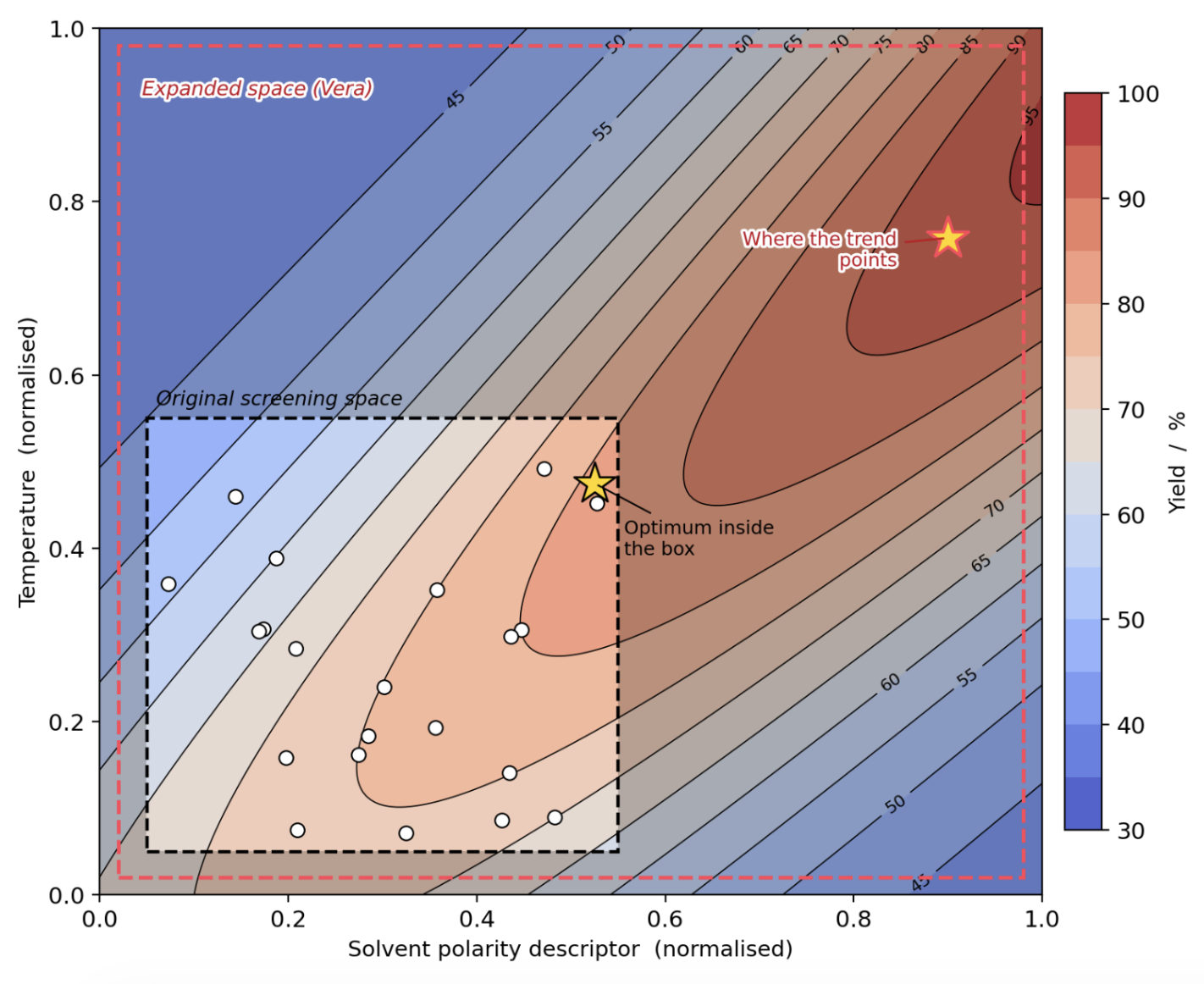
A Bayesian optimization campaign converges. The Pareto front flattens, the model grows confident, and each new suggestion sits within a hair of the last. The optimiser has done its job - it has found the best conditions within the space it was given.
That is not the same as finding conditions good enough to move forward. A campaign can converge on a yield that still falls short of the target, or an impurity that the regulator won’t accept. The campaign has reached the edge of what the chosen space allows - no further.
This is where Vera works. Rather than searching within fixed bounds, Vera reads the campaign as it actually stands - the descriptors behind each solvent and reagent, and the outcomes of every experiment run so far - and looks for the chemical trend running underneath the numbers. When yield tracks with solvent polarity, or selectivity follows a ligand's steric profile, that trend points somewhere the original panel never reached.
Vera follows it. Working from those same descriptors, the internal data, and the wider literature, Vera proposes conditions the screen never contained - a solvent class outside the initial set, a reagent that extends the trend rather than interpolating between known points. The reasoning stays grounded in what the experiments have already revealed, so the expansion is a considered next step rather than a guess.
The optimiser then does what it does well, on a space that is now re-defined and better chosen - and, often, one that finally contains a result worth taking forward.
Bayesian optimization finds the optimum inside the box. Vera reads the chemistry well enough to move the box.