
In process optimization, the “best” condition is rarely a single point. There’s usually a tradeoff.
In process optimization, the “best” condition is rarely a single point. There’s usually a tradeoff.
Most real campaigns are multi-objective: teams are balancing yield, selectivity, impurity profile, solvent choice, and downstream process constraints simultaneously. Optimizing one metric in isolation often creates problems elsewhere.
This is a key limitation of single-objective workflows (or workflows that collapse multiple outcomes into one weighted score too early): they can hide the tradeoffs that actually matter for decision-making.
At ReactWise, we support multi-objective Bayesian optimization with visualization tools that help teams explicitly interrogate those trade-offs.
A central example is the Pareto front.
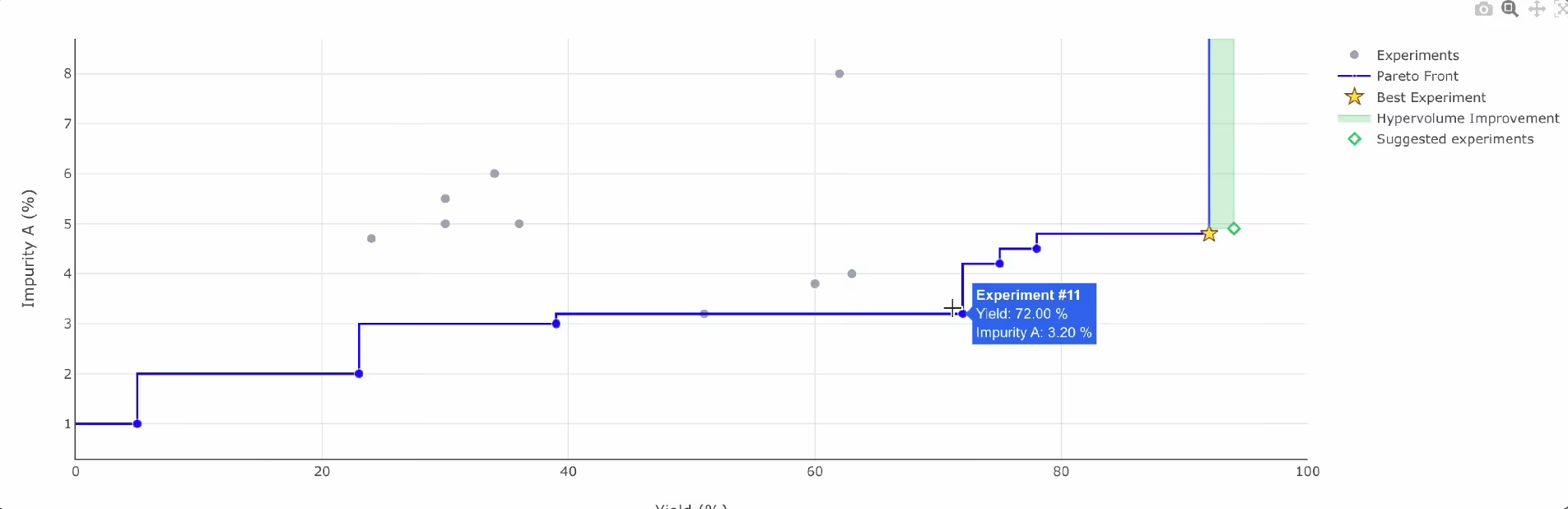
For a set of objectives (e.g., maximize yield, minimize impurity), the Pareto front represents the non-dominated conditions - the set of conditions where improving one objective requires sacrificing at least one other. This is often far more informative than a single “optimal” recommendation.
In practice, this helps teams answer questions such as:
- Is the highest-yield condition still possible, while meeting our regulatory impurity targets?
- Are there conditions with near-equivalent performance but better robustness or greener solvent choices?
- Where are the diminishing returns (e.g., a large impurity penalty for only a marginal yield gain)?
-
That is how we approach model-guided experimentation at ReactWise. See below for a short video of the pareto front of 2 competing objectives (high yield vs low impurity).
Our platform lets you set objective priorities explicitly - for example, weighting two objectives equally, prioritising one over another, or enforcing a hard constraint (e.g., impurity X must be below 1%) - and uses this to recommend the next experiment.
We believe optimization should not just produce recommendations - it should make tradeoffs visible, defensible, and actionable.