
I asked a process chemistry team leader recently how many tools his team uses just to run a reaction optimization project.
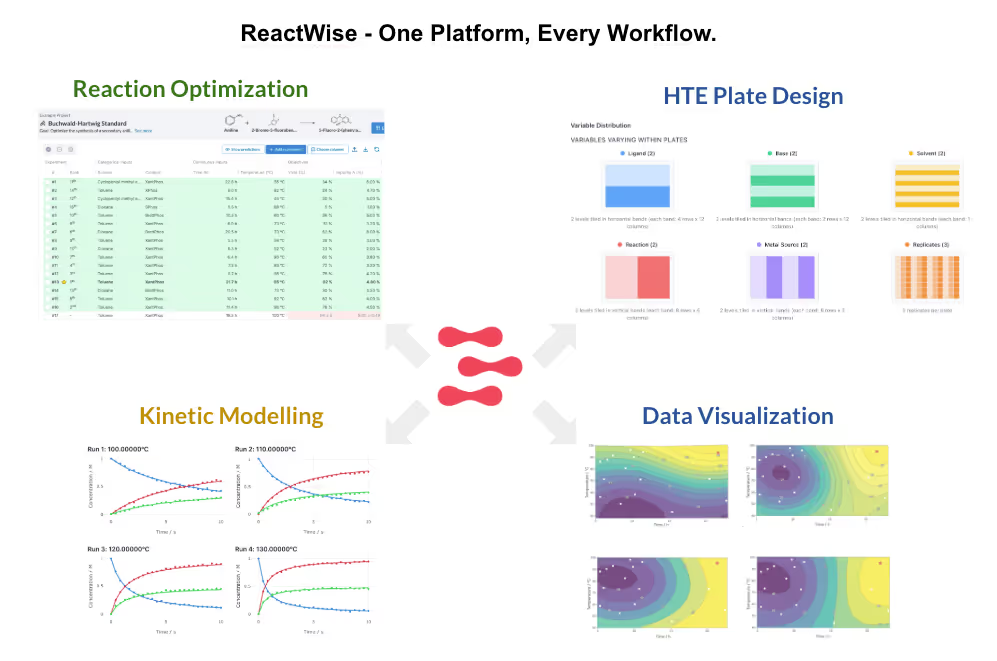
I asked a process chemistry team leader recently how many tools his team uses just to run a reaction optimization project.
He started counting.
One for designing experiments and planning HTE plate layouts. One for kinetic modeling. One for visualization. And yet another for data analysis.
Four platforms. Four logins. Four places for data to get lost in translation.
And between each of them, someone manually exporting a CSV or Excel file, reformatting it, and hoping nothing breaks in the process.
This is the hidden tax on every chemistry R&D team - and it's not a small one.
Context switching, reformatting data between tools, and reconciling outputs across platforms eats hours that should be spent on science.
It introduces errors. It slows down decision making. And it quietly drains the energy of some of the most talented scientists in the industry.
The tools weren't designed to work together. They grew organically - a best-in-class solution here, a legacy platform there - until the workflow became the bottleneck, not the chemistry.
This is exactly what @ReactWise was built to fix.
Reaction optimization, plate design, kinetic modeling, advanced visualization - one platform, one data model, no translation layer.
No more manual exports. No more reconciling outputs across disconnected systems - across the entire organization.
Everything your team generates stays connected, queryable, and ready to inform the next decision.
But we see ReactWise as more than a consolidation play. We see it as the intelligence layer of every modern chemical R&D lab - able to integrate with ELNs and existing data infrastructure to seamlessly fit into how your team already works.
Because the goal was never to replace the chemist.
It was to give them back their time - so they can focus on what they actually care about: the science and the experiments, not the data wrangling in between.