From plate design to a running liquid handler, in minutes.
The gap between a designed plate and an executing plate is usually a spreadsheet and an afternoon. Volumes, concentrations, deck positions, and a worklist file that has to be exactly right or the run fails. None of it is difficult. All of it takes time, and one mistake invalidates the plate.
Here’s how it works in @ReactWise now.
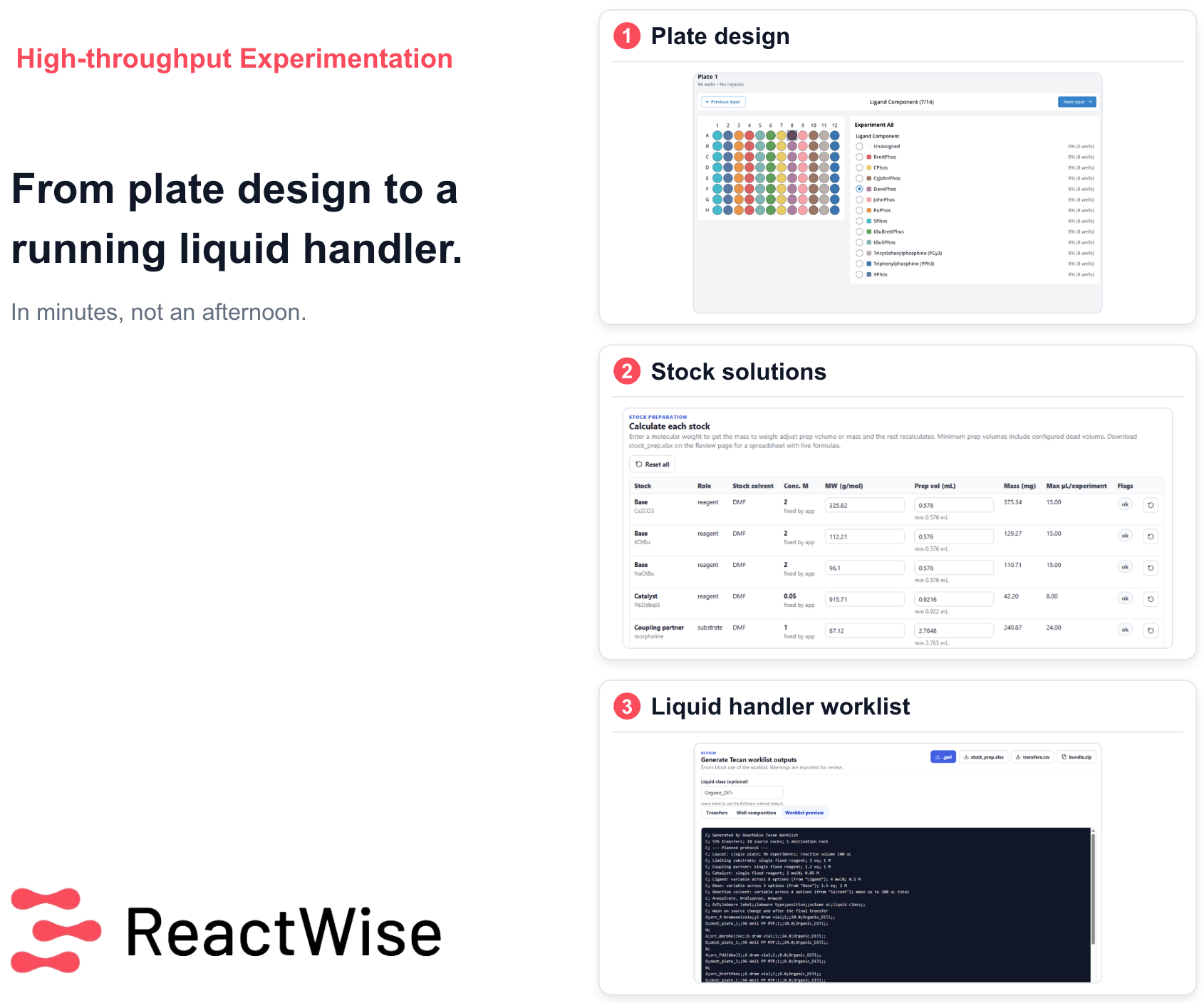
1. Choose the plate design. Discovery screen or process HTE - many substrates with one set of conditions, or one transformation with many conditions. Opposite problems, so the design is built differently from the start. Then let ReactWise propose the layout, or “drag-to-paint” it yourself if you already know what you want. Most people do some of both.
2. Get stock solution instructions. Exactly which ones to prepare, at what concentrations, in what volumes. No arithmetic.
3. Get your deck layout and worklist. Where each stock solution goes on the liquid handler, and a worklist file that drives the instrument directly. @Tecan supported today.
From design to a running plate without retyping anything in between.