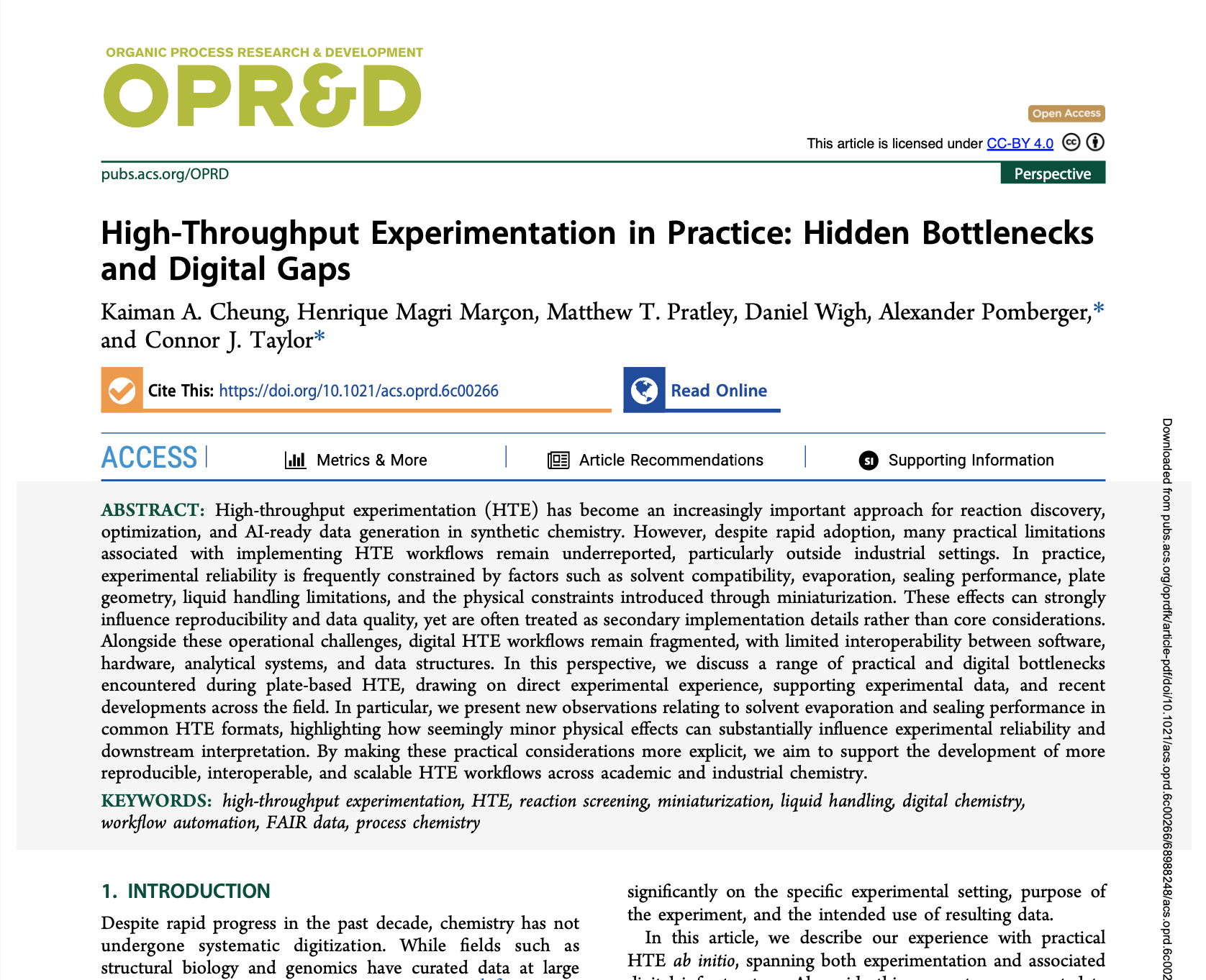
Data generation is the least glamorous step in AI-ready chemistry. We’ve been running our HTE lab for two years, and we’ve just published our key learnings in OPR&D.

October 29, 2026

Data generation is the least glamorous step in AI-ready chemistry. We’ve been running our HTE lab for two years, and we’ve just published our key learnings in OPR&D.

Three things worth knowing even if you never read it:

  1. Acetonitrile loses 13% of its mass in the first hour of an uncovered 96-well plate, and 33% by hour three. The concentration at the end of your screen is not the one you designed. DMF does the opposite and gains mass, pulling water from the air.
  2. A gradient across your plate may not be chemistry. We show a plate where the seal peeled from one edge. The internal standard rises steadily from row A to row H - a clean, convincing trend that is entirely evaporation.
  3. Six of sixteen common solvents are unsuitable for a standard polypropylene 384-well plate. THF, 2-MeTHF and toluene swell and warp the plate itself. The reactor is chosen before the chemistry is, and it narrows what you can run.

More wells is not the same as more chemical freedom. The second half of the paper covers the digital side: tools that don’t talk to each other, data locked in proprietary formats, and nothing that encodes the procedural logic a machine would need to run the plate.

None of this is novel chemistry. It’s the practical knowledge that usually gets learned once per lab and never written down, which is why it seemed worth publishing.

‍

Go Back