
Chemical descriptors for categorical parameters
Six catalysts, eight ligands, four bases. 192 combinations - before you consider temperature, solvent, or loading.
Optimization is often described in terms of continuous dials: temperature, equivalents, concentration. But some of the most important decisions in a reaction aren't dials at all. Which catalyst, which ligand, which base - these are discrete choices, and can multiply fast.
Continuous parameters are easy to reason about because you can interpolate. Discrete choices offer no easy equivalent - there is nothing "between" two ligands, until you describe them with what they actually are.
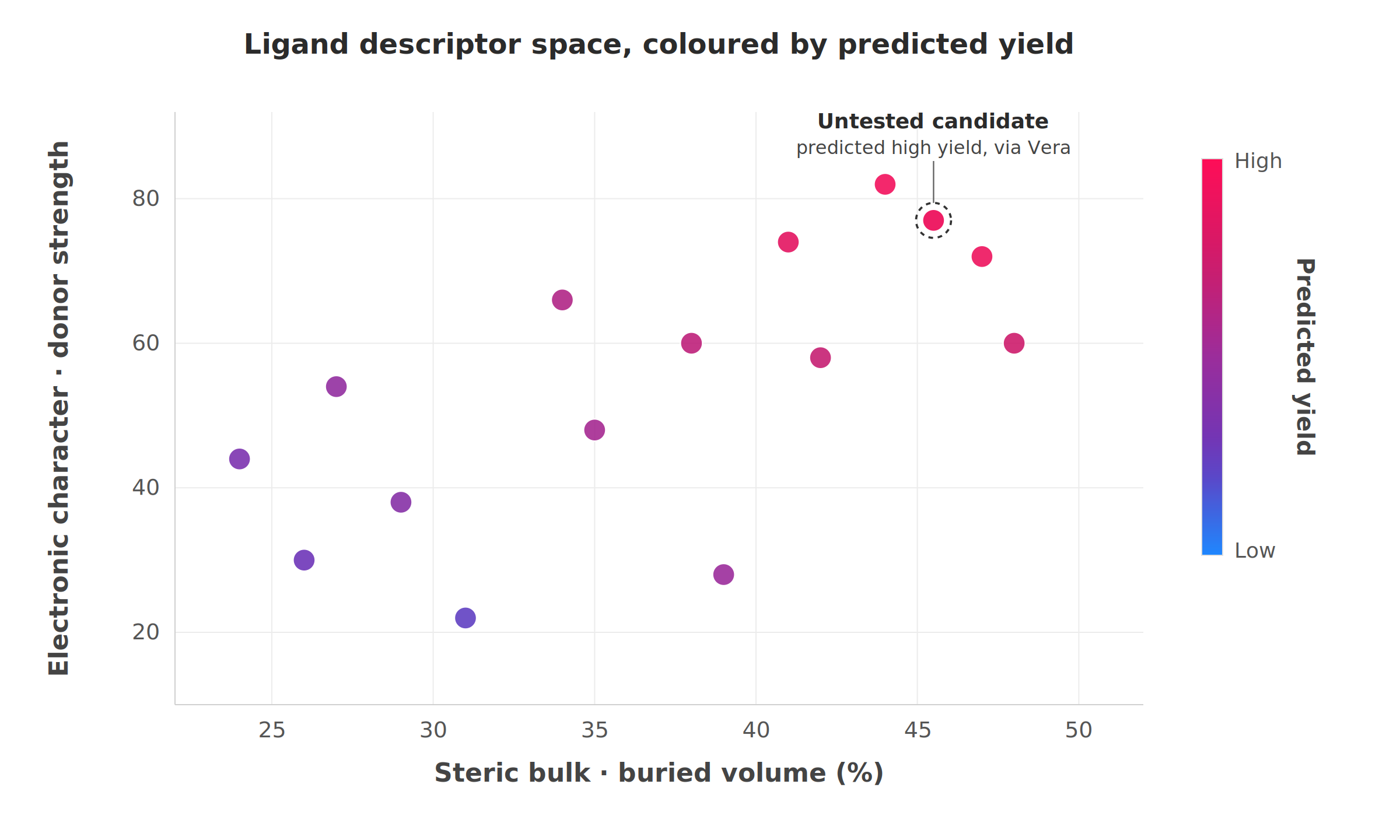
By encoding each catalyst, ligand, and base with physicochemical descriptors, our model can reason between them: recognizing that two ligands with similar steric and electronic profiles behave similarly, and that an untested one sitting between them is worth testing. Our SHAP-based plots then make those drivers visible - showing which descriptors are improving results, so the logic behind a recommendation is chemically understandable.
That turns a dense list into a navigable space. Rather than running all 192 combinations, the optimizer proposes the discrete choices most likely to be informative or high-performing, learns from each result, and narrows in. Vera, our AI assistant, goes further - suggesting catalysts or ligands beyond your original screen whose descriptors place them in promising regions, candidates you might not have thought to try.
If your team is staring down a catalyst, ligand, and base screen and wondering which combinations are actually worth running, we'd be glad to talk it through on your chemistry.