

Autonomous experimentation delivers the most value when capability is built in stages.
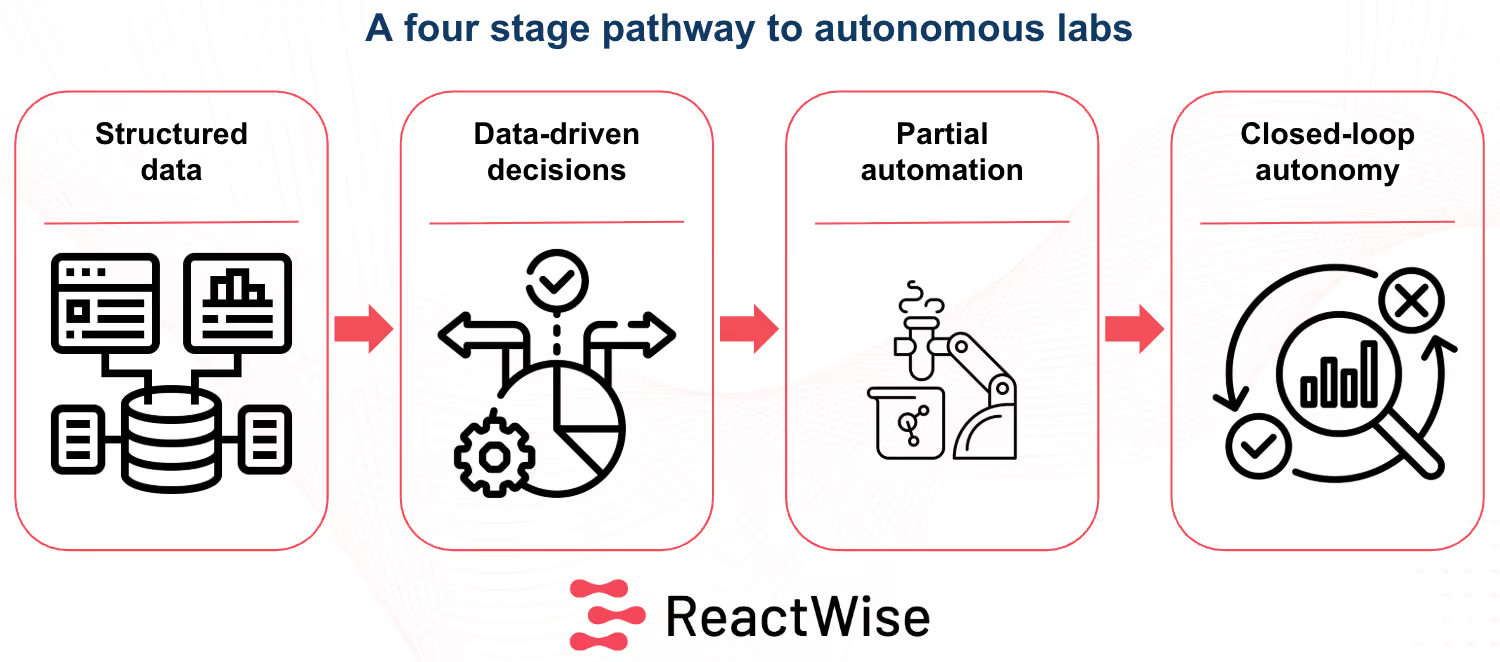
Autonomous experimentation delivers the most value when capability is built in stages.
Based on discussions with several partners and clients, at ReactWise we see the most effective path as a staged progression: first structuring data, then improving experiment selection, then reducing manual workflow overhead, and finally integrating models, hardware, and analytics into a closed loop.
Stage 1: Structured data capture
Self-driving workflows start with high-quality data. Experimental factors, responses, metadata, and context need to be captured in a consistent schema. Campaign templates help standardize variables, units, objectives, and analytical outputs across projects - creating the foundation for future optimization.
Stage 2: Data-driven decision support
Once data is structured, experimentalists can use methods such as Bayesian optimization to guide experiment selection without changing lab hardware. This balances exploration and exploitation, while ReactWise’s proprietary transfer learning algorithm - MemoryBO - uses historic campaign data to “warm-start” new optimizations.
Experiments may still be run manually, but experiment selection becomes statistically driven - often reducing the number of experiments needed for convergence.
Stage 3: Integration of automated data-analytics
The next step is to speed up the feedback loop; this means automated ingestion of analytical outputs such as HPLC, LC-MS or IR data. This reduces manual transfer between disconnected systems, improving throughput and reducing transcription risk.
Stage 4: Closed-loop execution
Only once all other stages are complete, is full autonomous experimentation beneficial. In a closed-loop workflow, the platform designs experiments, sends parameters to hardware, ingests analytical results, updates the model, and selects the next experiments automatically.
The result is faster convergence, fewer manual interventions, and greater reproducibility.
Autonomy does not need to begin with robotics-heavy infrastructure. In many cases, the highest-leverage first step is structured data capture and rigorous experiment selection. If you're exploring autonomous experimentation and want to take a staged, practical approach, we’d be happy to share what that could look like in your lab.