
5 mol% of a palladium catalyst hits the target yield.1 mol% of catalyst might come within one percent of the yield of it - at just a fifth of the cost.
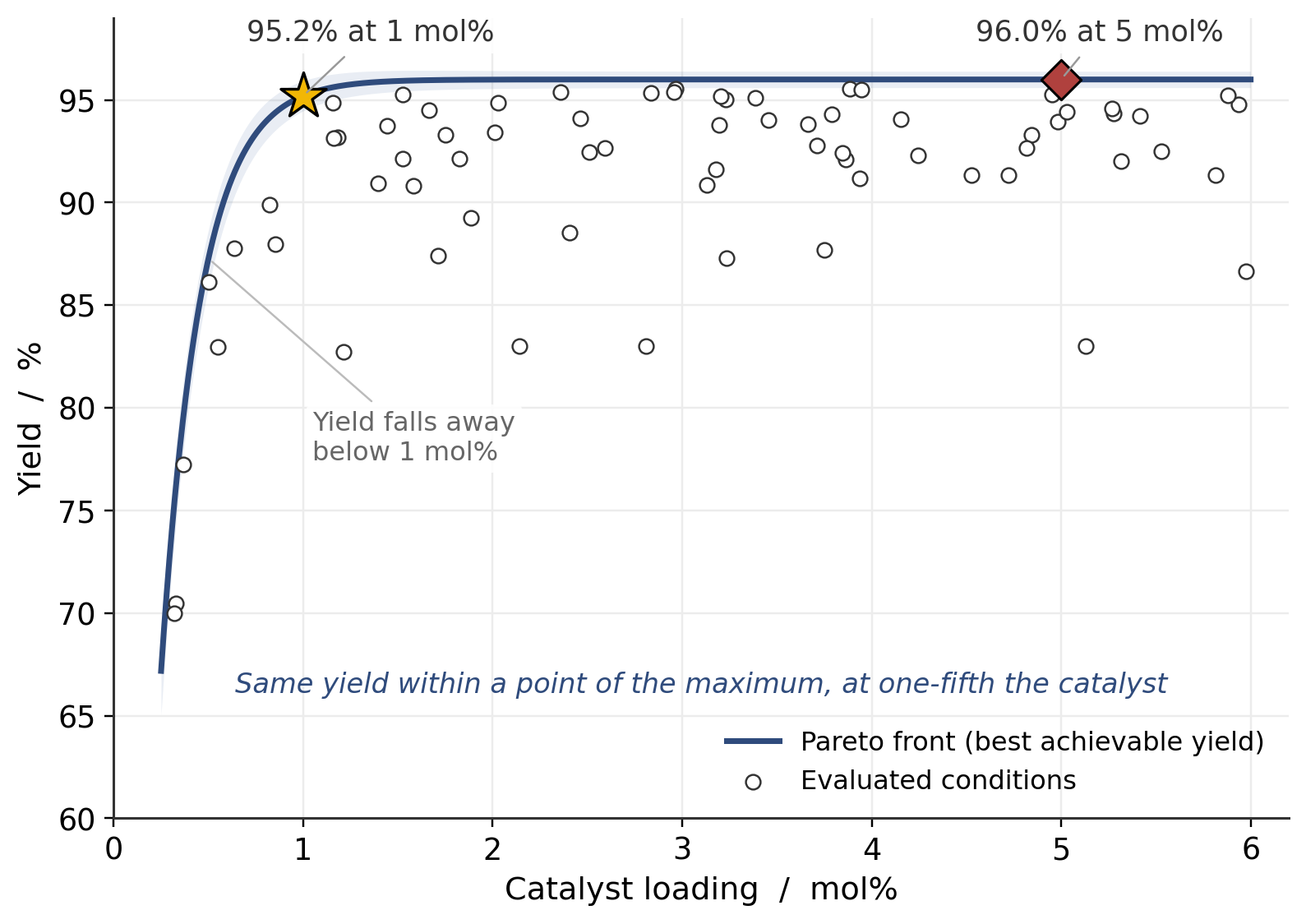
5 mol% of a palladium catalyst hits the target yield.1 mol% of catalyst might come within one percent of the yield of it - at just a fifth of the cost.
Most optimization treats the objective as something measured after the reaction - yield, impurity, selectivity - and the input parameters as dials to be tuned. But several of those inputs carry a cost of their own. Catalyst and ligand loading, reagent equivalents, and temperature can all return later as expense, waste, or a process that is harder to maintain at scale.
The line between an input and an objective is more flexible than it looks. A parameter that is normally an input can also be treated as something to optimize - so the campaign asks not only which conditions maximize yield, but also how little catalyst is needed.
In ReactWise, any input can be added as an objective alongside the measured responses. Because its value is known exactly - with no analytical uncertainty - it enters as a precise term traded off against the responses that have to be measured. The result is a Pareto front: how much yield is lost by decreasing the loading, and where the saving is no longer worth taking.
Cost then becomes something shaped during development, not reviewed once the process is fixed - the same target met more cheaply, chosen rather than found late.
If your team is weighing performance against cost of goods early in development, we would be glad to talk through how this looks on your chemistry - link in the first comment.